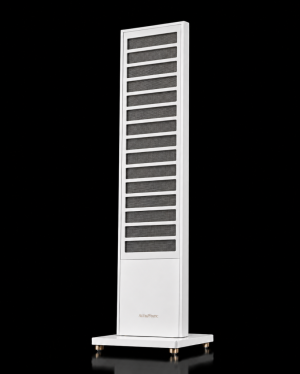
AudioStatic Electrostatic Speakers
The Art of Electrostatic Sound Reproduction
AudioStatic is dedicated to one of the purest forms of loudspeaker technology: the electrostatic loudspeaker.
Unlike conventional speakers that use cones, voice coils and magnets, an AudioStatic electrostatic speaker uses an extremely thin and lightweight diaphragm suspended between two stators.
Almost the entire surface of this diaphragm is driven simultaneously by an electrostatic field.
This fundamental difference gives electrostatic loudspeakers their distinctive ability to reproduce music with exceptional speed, transparency, detail and spatial realism.
At AudioStatic, the objective is simple:
to reproduce the original musical signal as naturally and accurately as possible.
Why Electrostatic Speakers?
Every loudspeaker has to move air to create sound.
The way in which this is achieved has a major influence on what we ultimately hear.
Traditional dynamic loudspeakers use a relatively heavy combination of cone, voice coil and suspension.
An electrostatic loudspeaker works with a diaphragm that has extremely little moving mass.
Because there is so little mass to accelerate and decelerate, the membrane can respond exceptionally quickly to changes in the musical signal.
This makes electrostatic speaker technology particularly suitable for listeners who value:
-
transparency;
-
speed;
-
fine detail;
-
low distortion;
-
natural vocals;
-
precise imaging;
-
open sound reproduction;
-
a realistic three-dimensional soundstage.
For many audiophiles, these qualities are what make electrostatic speakers so compelling.
How Does an AudioStatic Electrostatic Speaker Work?
At the heart of an electrostatic loudspeaker is an ultra-thin diaphragm.
This diaphragm is electrically charged and positioned between two carefully constructed stators.
The music signal creates a changing electrostatic field between the stators. This field causes the diaphragm to move backwards and forwards.
Because the electrostatic force acts across almost the complete surface of the membrane, the diaphragm is driven in an exceptionally uniform manner.
There is no conventional voice coil attached to one small area of the diaphragm.
Instead, the entire radiating surface participates in reproducing the audio signal.
This is one of the key principles behind the remarkable clarity and low distortion associated with high-quality electrostatic loudspeakers.
An Extremely Lightweight Diaphragm
Moving mass is one of the most important factors in loudspeaker performance.
A heavy driver takes more energy to start moving and more energy to stop.
The diaphragm of an electrostatic speaker is exceptionally light.
Its mass is dramatically lower than the combined moving mass of the cone, voice coil and suspension found in a conventional loudspeaker driver.
This enables the membrane to respond almost instantaneously.
The result can be heard in the smallest musical details.
The attack of a piano note.
The movement of a bow across a string.
The subtle breath of a vocalist.
The decay of a cymbal into the acoustic space of the recording.
These details are not artificially emphasised. They become audible because the diaphragm is capable of following the music signal with great precision.
Full-Surface Drive
One of the defining characteristics of electrostatic technology is full-surface drive.
In a conventional loudspeaker, the cone is driven by a voice coil connected around its centre.
The mechanical force therefore originates from a relatively small part of the driver.
In an electrostatic loudspeaker, the force is distributed across almost the entire diaphragm.
The membrane moves as one large radiating surface.
This reduces mechanical stress and helps the diaphragm reproduce complex musical signals with exceptional consistency.
The combination of low mass, large surface area and minimal excursion contributes to the clean and effortless character associated with electrostatic speakers.
Transparency
Transparency is one of the qualities most closely associated with AudioStatic electrostatic loudspeakers.
A loudspeaker should ideally contribute as little of its own character as possible.
The listener should hear the recording, not the loudspeaker.
Because electrostatic panels use an exceptionally lightweight diaphragm and uniform drive, very small changes within the musical signal can remain intact.
This can reveal information that is easily masked by conventional loudspeaker systems.
On a high-quality recording, the result is not simply more detail.
It is a stronger sense of realism.
Voices and Acoustic Instruments
Human hearing is exceptionally sensitive to the sound of the human voice.
Small changes in tone, resonance and articulation are immediately noticeable.
For this reason, vocal reproduction is one of the most demanding tests for any high-end loudspeaker.
Electrostatic speakers are particularly well suited to this task.
A well-recorded voice can appear remarkably natural and present, without sounding as though it originates from a conventional speaker cabinet.
The same applies to acoustic instruments.
Strings, piano, guitar, percussion and wind instruments contain extremely complex harmonic structures.
The fast response of an electrostatic diaphragm helps preserve these fine tonal differences.
Three-Dimensional Soundstage
Most AudioStatic electrostatic panels operate as dipole loudspeakers.
Sound is radiated both forwards and backwards.
This creates a fundamentally different interaction with the listening room compared with a conventional box loudspeaker.
When correctly positioned, the reflection of the rear radiation contributes to the perception of depth and space.
The result can be a large and highly three-dimensional soundstage.
Instead of hearing sound attached to the physical loudspeakers, voices and instruments can appear at clearly defined positions in the room.
A singer may appear directly between the speakers.
An instrument may be positioned further behind.
The ambience of the recording venue can extend beyond the physical dimensions of the loudspeaker system.
This ability to recreate acoustic space is one of the most fascinating characteristics of electrostatic sound reproduction.
The Loudspeaker Disappears
One of the greatest compliments that can be given to a high-end loudspeaker is that it disappears.
Not physically, but acoustically.
When stereo imaging, phase behaviour, room placement and recording quality come together, the listener stops hearing two loudspeakers.
Instead, a musical performance appears in the listening space.
This is one of the central objectives behind AudioStatic electrostatic loudspeaker design.
The technology should not draw attention to itself.
It should allow the recording to speak.
Exceptional Transient Response
Music consists of constantly changing signals.
A drum strike, the plucking of a guitar string or the initial impact of a piano hammer happens extremely quickly.
A loudspeaker must therefore be capable of accelerating and stopping with great precision.
Because an electrostatic diaphragm has exceptionally low mass, its transient response can be extremely fast.
This does not mean that the sound has to be sharp or aggressive.
True speed is about control.
The membrane follows the signal and stops when the signal stops.
This contributes to clarity, timing and a natural sense of musical rhythm.
Low Distortion
Every loudspeaker introduces some degree of distortion.
The objective of high-end loudspeaker engineering is to minimise it.
The operating principle of an electrostatic speaker offers several advantages.
There is no heavy voice coil attached to the diaphragm.
There is no conventional cone.
The membrane requires only minimal movement.
And the driving force is distributed over a very large surface area.
These properties help reduce many forms of mechanical distortion.
The result is a sound presentation that can remain remarkably clean, even when reproducing complex musical information.
Open Dipole Reproduction
The open construction of an electrostatic panel contributes strongly to its distinctive sound.
Many traditional loudspeakers place the drivers inside an enclosure.
That enclosure has to control the energy produced by the rear of the driver.
An electrostatic dipole panel operates without a conventional closed loudspeaker cabinet around its radiating surface.
The front and rear sound waves are allowed to interact naturally with the listening room.
This open architecture contributes to the spacious and unrestricted presentation for which electrostatic loudspeakers are known.
Engineering an Electrostatic Loudspeaker
The apparent simplicity of an electrostatic speaker can be misleading.
A membrane suspended between two stators may look straightforward, but achieving high-level performance requires precise engineering.
Many parameters influence the final result, including:
-
diaphragm thickness;
-
diaphragm material;
-
membrane tension;
-
stator geometry;
-
stator spacing;
-
electrical insulation;
-
electrostatic charge;
-
high-voltage stability;
-
audio transformer design;
-
panel dimensions;
-
mechanical rigidity;
-
acoustic behaviour;
-
dispersion;
-
resonance control.
All these elements interact.
Changing one parameter can affect several others.
Electrostatic loudspeaker development therefore requires a careful balance between electrical engineering, mechanical construction and acoustics.
Electrostatic Speakers and Room Placement
A high-end electrostatic speaker deserves careful positioning.
Because the panel radiates sound forwards and backwards, the distance to the rear wall has a significant influence on the final presentation.
The orientation of the loudspeakers relative to the listening position also affects imaging and tonal balance.
Correct setup can improve:
-
stereo imaging;
-
soundstage width;
-
soundstage depth;
-
vocal placement;
-
tonal balance;
-
bass integration;
-
overall realism.
Small changes in positioning can sometimes make surprisingly large differences.
For this reason, electrostatic speakers should not simply be placed where conventional loudspeakers previously stood.
They should be positioned as part of the complete acoustic system.
Designed for the Serious Listener
AudioStatic electrostatic loudspeakers are intended for listeners who want more than impressive specifications.
They are for people who listen to music critically and emotionally.
For people who notice the difference between hearing a recording and experiencing a performance.
For people who value natural timbre over exaggerated effects.
And for people who want their audio system to reveal more of what was captured during the original recording.
Why Choose AudioStatic Electrostatic Speakers?
The attraction of an electrostatic loudspeaker cannot be explained by one specification.
It is the combination of many characteristics:
exceptionally low moving mass
full-surface diaphragm drive
fast transient response
low distortion
open dipole radiation
precise stereo imaging
natural vocal reproduction
fine musical detail
a spacious three-dimensional soundstage
Together, these qualities define the listening experience that electrostatic loudspeaker enthusiasts have valued for decades.
AudioStatic – When the Loudspeaker Makes Way for the Music
High-end audio should ultimately be about music.
Not technology for the sake of technology.
Not exaggerated bass.
Not artificial detail.
Not a loudspeaker imposing its own character on every recording.
The ambition of AudioStatic electrostatic loudspeakers is different.
To reproduce the signal with speed and precision.
To preserve the smallest musical details.
To create space and depth.
To allow voices and instruments to appear naturally in the listening room.
And, ultimately, to make the loudspeaker itself disappear.
AudioStatic
Electrostatic sound reproduction for listeners who want to hear more of the music.